
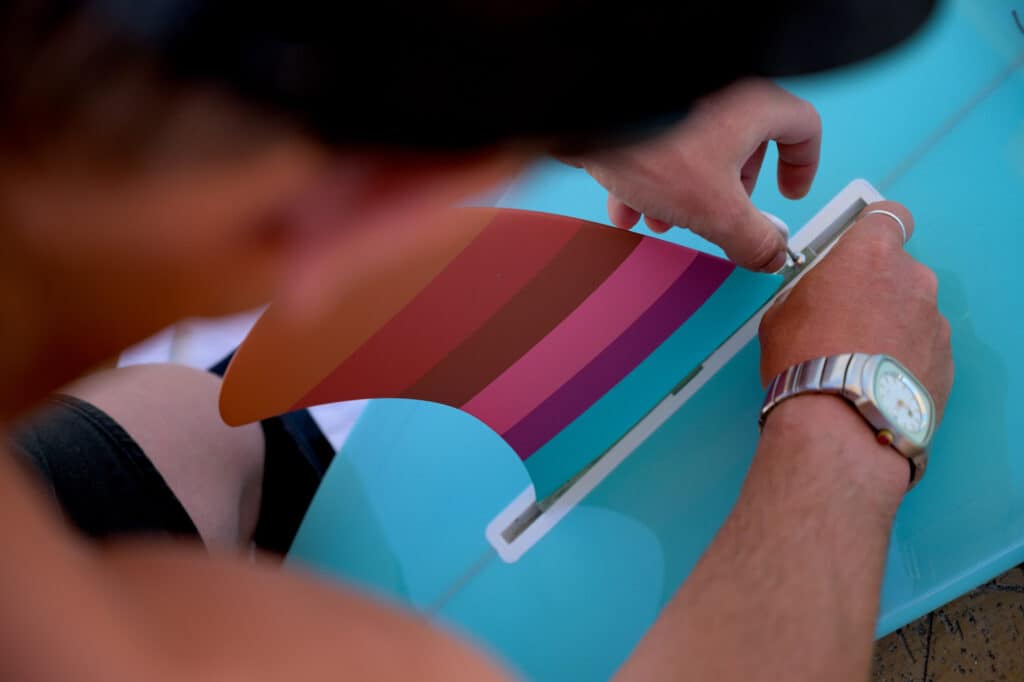
Surfboard fins are a crucial part of your surfboard setup. Choosing fins that work best for you and your surfboard depends on size, riding style, and your surfboard’s fin box. Before talking about fin size or different fin configurations, it is important to distinguish between glassed-in and swappable fins.
Glassed-In vs Swappable (Removable)
Fins Glassed-in fins:
Are laminated into the surfboard. As you might imagine, a glassed-in fin might be smoother and sounder than a removable fin. However, glassed-in fins are difficult to repair and do not offer you any versatility of removable fins.
Removable fins:
Can be added or removed using a fin key and adjusting the small (typically stainless steel) inset screws. Don’t force your fins into the box as that may damage your board or the fin. Center and outside fins have different shapes, so make sure you are using the right fin for the right box. Once your fins are in place, tighten your screws with the key, making sure the fins are secure but not too tight.
Dual Tab (FCS & FCS II) Fin BoxesFCS stands for Fin Control System.
Designed in the early 1990s, FCS is the most successful, widely used surfboard fin system in the world. The fins have two tabs or plugs that are secured to the board using set screws. FCS recently launched the FCS II keyless Fin Standard, meaning fins can be installed or removed without a key or grub screws. FCS II is also backwards compatible, meaning you can use your old dual tab FCS fins with the new FCS II system. The only downfall is they can damage your board if you hit something in the water like kelp.
Single Tab (Futures) Fin Boxes
The other major player in fin boxes, Futures Fins, connect to your board using a Truss Base along the entire length of the fin box (unlike plugs) for a strong, lightweight connection. Quick and easy set screws hold the fins in place.
Choosing Your Fins
When choosing fins for your surfboard, you should start with your weight. Choosing the appropriate fin size is the first essential step to choosing the right fins. Once you have decided on a size, examine your board’s fin configuration, or fin setup. Your board will be outfitted with 1 to 5 fin boxes.
Fin Size
The following chart is evo’s recommended fin size according to rider weight. If you are in between sizes, consider the type of board or type of waves you will be riding with that particular setup. For example, if you are in between size M and L, you might pick size M fins for your small wave board, but size L fins for your big wave board.
| Size | Weight (Kgs) |
|---|---|
| Grom | <45 |
| XS | <54 |
| S | 48 -70 |
| M | 65 – 89 |
| L | 75+ |
| XL | 86+ |
Fin Configuration
Once you’ve decided on your fin size, you need to understand your board’s fin configuration. To determine your fin configuration, examine the base of your surfboard near the tail. The number of fin boxes you see is the fin configuration and will likely range from 1-5.
The most common surfboard fin setups are Single, Twin, Thruster and Quad. Some boards are equipped with 5 Fin boxes so you can mix and match more easily, while more and more boards are now fitted with a longboard single fin box and regular side fin boxes called 2+1.
Single Fin
A single fin box is most common on longboards and is the most traditional surfboard fin configuration. Turning with a single fin is limited, meaning single fins are ideal for fast, straight shot surfing. Single fins will provide stability, control, and predictability to your longboard. Longboard single fin boxes are long and allow you to move the fin forward for a looser feel, or further back for more control.
Twin Fin
Twin fins or a dual fin configuration will make your surfboard fun, playful, and maneuverable. Two fin setups are not ideal for big-wave riding and are commonly featured on shortboards to enhance their speed. Twin fins offer a skatier feel and longer, more drawn out turns.
Thruster/Tri Fin
Nowadays, 3 fins is the most common configuration and can be found on a variety of surfboard shapes and sizes. The two outer fins are closer to the middle of the board, angled towards the board centre (“toed-in”) and can be flat on the inside in order to increase water tracking and speed.
The centre fin is the closest to the tail and is symmetric on both sides for stability (see Foil for more info). Tri-fins perform well because they add stability, control, and manoeuvrability that beginners to pros excel on. A thruster configuration also gives you options – ride twin or single if you want!
Quad Fin
Quad fin configurations offer speed in smaller surf by channeling the water to the end of the surfboard and out the tail for acceleration. Two fins near the rails of your surfboard will also add stability and hold in big-wave surfing. Lastly, quad fins are great for generating drive through turns.
5-Fin
Five fin configurations are not meant to be surfed with all five fins. Five fin boxes allow you to mix and match fins depending on your preference and the surf conditions. Swap from the freedom of a twin fin, to the traction of a thruster, to the speed of a quad without changing boards.